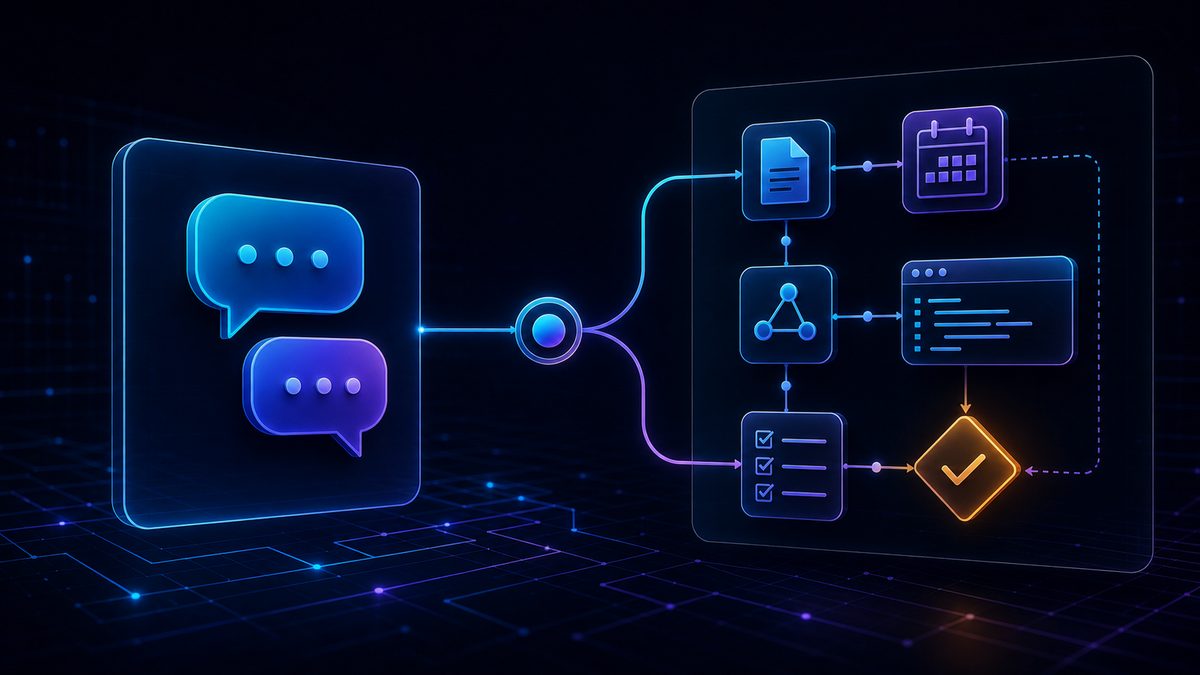
TL;DRif you only keep one line from this note ChatGPT is best treated as a thinking surface; an AI agent is best treated as a delegated worker with tools, memory, and a finish line.
Most AI confusion starts because people use one word for several different things.
ChatGPT, Claude, Gemini, and similar products often feel like "AI" as a single category. You ask a question, get an answer, refine the answer, and move on. That is already powerful. But it is not the same thing as an AI agent.
The difference matters because the operating model changes.
If you ask ChatGPT to help you think through a pricing strategy, you are still driving. If you ask an agent to research competitors, draft a comparison table, create a file, check it, and report back, you are delegating a bounded job. If you wire that agent into a repeatable publishing or reporting system, you are no longer just chatting. You are building a workflow.
The Short Version
Use a chat assistant when the task is fuzzy, exploratory, conversational, or judgment-heavy.
Use an agent when the task has a concrete output, accessible tools, clear boundaries, and a checkable result.
Use a workflow when the task repeats often enough that you need stages, handoffs, status, approvals, and records.
That is the whole distinction.
Chat Is a Thinking Surface
Chat is strongest when the value comes from back-and-forth thinking.
Good chat tasks look like this:
- Explain this topic to me in simpler language.
- Help me compare two options.
- Turn my rough notes into a clearer plan.
- Challenge my assumptions.
- Draft a message, then revise the tone.
The user is still the operator. The assistant is a reasoning partner, editor, tutor, or second brain for the current conversation.
That makes chat great for ambiguity. You can be messy. You can change direction. You can ask for examples, objections, analogies, rewrites, and tradeoffs.
But chat has a ceiling: it usually depends on you to keep the thread moving.
Agents Are Delegated Workers
An AI agent starts to matter when the system can do more than answer.
An agent may be able to inspect files, run code, search a repo, update a document, call an API, use a browser, write to a database, create a pull request, or report progress while it works.
That changes the question from:
What should I think?
to:
What job can I safely hand off?
A useful agent task has a noun, a verb, and a finish condition:
- Review this pull request and list the top risks.
- Add a Labs post and deploy it.
- Summarize these transcripts into topic candidates.
- Check whether the new public routes leak internal metadata.
- Create a reel package from this approved blog post.
Agents are not magic because they are smarter. They are useful because they can carry context through a task, touch tools, and return with evidence.
The Danger Zone
The worst tasks for agents are vague but operational.
"Make the website better" is too loose.
"Improve the Labs homepage by making the post cards easier to scan on mobile, then run a visual check at desktop and phone widths" is much better.
The agent needs a boundary. Without one, it may wander, overbuild, change unrelated files, or optimize for the wrong thing.
Agents also need permission rules. A good agent should know what it can read, what it can edit, what it must never expose, and when it should stop for human approval.
That is why the boring parts matter: status labels, gates, logs, source IDs, canonical URLs, test checks, and private/public boundaries.
The Third Category: Workflows
A workflow is what you build when one good agent run is not enough.
For example, a publishing workflow might look like this:
- Lead
- Approved Topic
- Draft Blog/Post
- Published URL
- Reel Package
- Social Handoff
Each stage has a job. Each stage can have a human approval point. Each stage leaves behind metadata the next stage can use.
This is where agents become part of an operating system instead of a novelty.
The important shift is that the workflow owns the process. The agent helps execute a stage. The human owns judgment and taste.
A Practical Rule
Before using AI, ask what shape of help you need.
If you need clarity, use chat.
If you need a bounded deliverable, use an agent.
If you need repeatability, use a workflow.
Here is the simple version:
- ChatGPT-style assistant: think with me.
- Agent: do this job and show your work.
- Workflow: move this item through the system.
The mistake is expecting one interface to do all three equally well.
What This Means for Builders
For builders, the real leverage is not choosing between ChatGPT and agents as if they are rival products.
The leverage is matching the tool to the job.
A chat assistant helps shape the idea.
An agent turns a defined piece of the idea into an artifact.
A workflow makes sure the artifact moves through review, publishing, reuse, and measurement.
That is the stack.
Not "AI replaces work."
More like: AI changes where the work lives.
Some work stays in conversation. Some work moves into delegated tasks. Some work becomes a system.
Knowing the difference is the beginning of using the whole thing well.